DifabelZone
1. High-Level Architecture
DifabelZone is a single deployable Spring Boot application organized in strict layers: HTTP entry points on top, business logic in the middle, and persistence at the bottom. Every request crosses the same security boundary before reaching a controller.
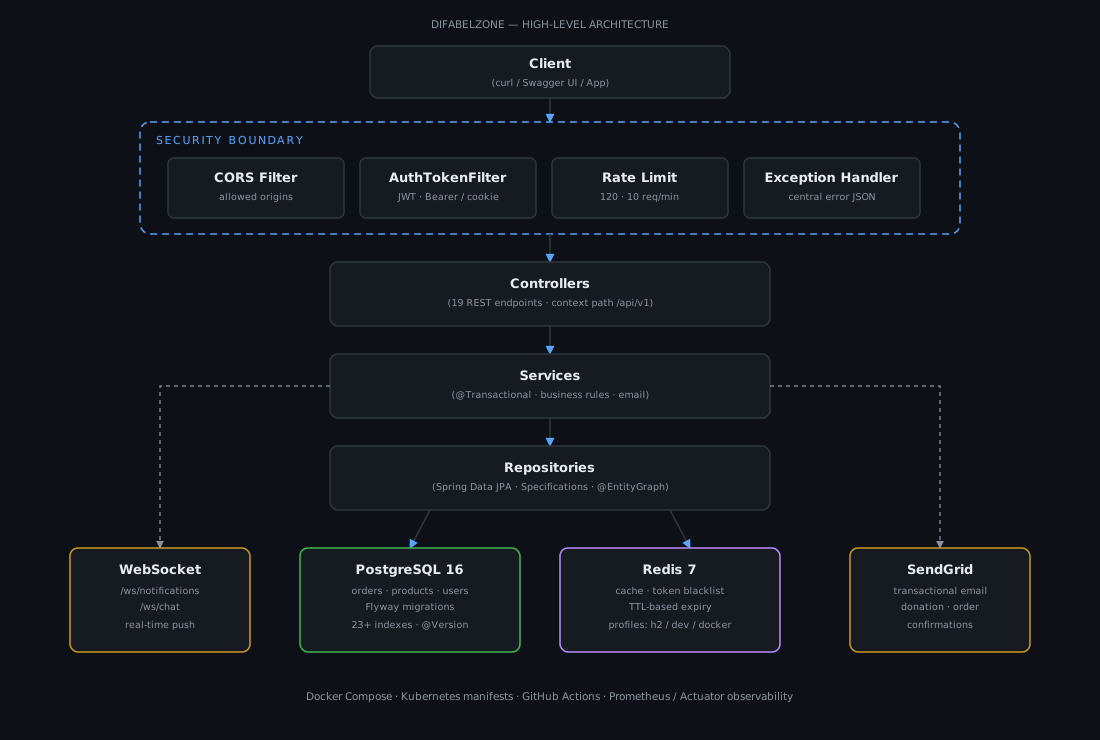
- Request flow. A JWT from the
Authorization: Bearerheader or an HttpOnly cookie is parsed byAuthTokenFilter, which loads the user, validates the token against the blacklist, and seedsSecurityContext. TheRateLimitInterceptorthen guards throughput before controllers run. - Security boundary placement. Token validation, rate limiting, and exception translation all sit in the filter chain — before any business logic, so unauthorized or abusive traffic never touches the service layer.
- Async surfaces. WebSocket handlers under
/ws/notificationsand/ws/chatpush real-time updates (persisted first, then broadcast), and SendGrid sends transactional email asynchronously.
2. Project Overview & Context
The Problem. Standard e-commerce platforms do not surface accessibility information, do not distinguish disability-owned businesses, and give donors no structured way to support accessibility-focused campaigns. Verification of business owners, accessibility attributes of products, and donation tracking are all ad-hoc and manual.
The Goal. Build a secure, documented, scalable REST API — under /api/v1 with OpenAPI/Swagger UI — that runs the full inclusive-commerce loop: catalog, cart, orders, reviews, DOB verification, donation crowdfunding, and real-time notifications, with hardened auth and observability built in from the start.
3. Core Backend Logic & Features
Role-Based Access Control (RBAC)
Three roles — ROLE_USER, ROLE_SELLER, ROLE_ADMIN — are seeded with a @JoinTable user_role many-to-many relation. URL-level rules are enforced in SecurityConfig (/admin/** admin-only, /auth/** and GET /public/** open, everything else authenticated), while fine-grained ownership rules are enforced in the service layer: only the seller who owns a product can edit it, only the owner of a review/address can mutate it, and only the owner of a wishlist can modify it.
Business logic
- Order placement (checkout). A single
@Transactionalmethod validates the address, snapshots price and discount intoOrderItem, decrements stock per line, clears the cart, and writes anOrderStatusHistoryrow plus an email + notification — all-or-nothing. - Donation crowdfunding. Donating to an active wishlist increments
collectedAmount; when it reaches the target the wishlist auto-transitions toFUNDEDand the beneficiary gets a notification. Self-donation to your own wishlist is rejected. - Flash-sale scheduling. Start/end times are validated and overlapping sales for the same product are rejected so a product never has two concurrent promotions.
- Review integrity. One review per (product, user) is enforced at the database level (
findByProductProductIdAndUserUserId) — duplicates are rejected and updates must go through PUT.
Security & auth
- JWT pair — 30-minute access token (Bearer header or HttpOnly cookie) + 7-day refresh token with rotation; login revokes the user's old refresh tokens.
- Token blacklist — logout blacklists the JWT in Redis (TTL = remaining lifetime) in the
dockerprofile, or an in-memory map onh2/dev. - Brute-force protection —
FailedLoginTrackerrequires reCAPTCHA after 3 failed logins;RateLimitInterceptorenforces 120 req/min general and 10 req/min on auth endpoints (HTTP 429). - Observability — a
CorrelationIdFilterpushes a trace ID into the MDC for every request, and Prometheus metrics are exposed via Actuator.
4. Database & Data Modeling
Database choice. PostgreSQL 16 in production (with Flyway-managed migrations) because of its relational integrity for order/transaction data, plus H2 for fast in-memory dev/test. Redis 7 is added as a cache and token-blacklist backend only where it is needed.
Key relationships (ERD highlights):
| Relation | Cardinality | Note |
|---|---|---|
| User ↔ Role | M:N | join table user_role |
| User → Cart / Wishlist / RefreshToken | 1:1 | one per user |
| Product → Category | N:1 | category_id |
| Product → ProductImage | 1:N | isPrimary flag |
| Product ↔ AccessibilityAttribute | M:N | core accessibility feature |
| Order → OrderItem | 1:N | price snapshot at purchase time |
| Order → Payment | 1:1 | payment-gateway fields stored |
| DonationWishlist → Donation | 1:N | aggregates collectedAmount |
Performance strategy.
- Pagination everywhere via
Pageable+ aPagedResponse<T>envelope — never return unbounded lists. - Dynamic filtering with
JpaSpecificationExecutor(keyword, category, price range, stock, accessibility attributes). - 23+ indexes added through Flyway migrations on the hot FK/lookup columns.
- Anti-N+1 with
@EntityGraph(roles)andLEFT JOIN FETCHon orders. - Optimistic locking via
@VersiononProduct,Order, andCartto keep concurrent writes consistent.
5. Tech Stack & Engineering Trade-offs
| Concern | Choice |
|---|---|
| Language / Framework | Java 17 + Spring Boot 3.4 |
| Persistence | PostgreSQL 16 + Hibernate 6 + Flyway |
| Cache | Redis 7 (Spring Data Redis) |
| Auth | Spring Security 6 + JJWT 0.12.6 |
| API docs | SpringDoc OpenAPI / Swagger UI |
| SendGrid | |
| Realtime | Raw Spring WebSocket |
| Deploy | Docker Compose + Kubernetes + GitHub Actions |
Trade-off decisions.
- Spring Boot + Java over a lighter stack: the ecosystem gives us first-class transaction management, declarative security filters, and mature JPA — critical for an app where money (orders, donations) moves through transactions.
- Redis-backed blacklist behind an interface (
TokenBlacklistService) with profile-based implementations (in-memory vs Redis): production-grade invalidation without slowing down local dev, and the choice is a single bean — not a rewrite. - Raw WebSocket over STOMP: fewer moving parts for simple push-notification delivery; the trade-off is that we implement session management and auth ourselves.
- Record-based DTOs + ModelMapper: immutable payloads with less boilerplate at the cost of a small reflection overhead, acceptable at this request volume.
6. Engineering Challenges & Solutions
The Challenge — keeping stock consistent under concurrent orders. Two orders checking stock and decrementing it in the same window could both pass validation. Read-then-write inside a transaction is safe against partial writes, but not against lost updates.
The Solution. @Version optimistic locking on Product, Order, and Cart — the entity version is incremented on every update, and a conflicting write fails with ObjectOptimisticLockingFailureException instead of silently overwriting. Combined with snapshotting price/discount into OrderItem, order history stays correct even if the catalog price later changes.
The Challenge — invalidating tokens and scattered joins. Logout needs the JWT to die immediately, and lazy loading could hammer the DB with N+1 queries on user/order reads.
The Solution. A dual-backend blacklist service (Redis with TTL, in-memory fallback for dev) plus @EntityGraph/JOIN FETCH on the read-heavy aggregates. @Cacheable("productById") / ("categories") with @CacheEvict on writes keeps reads cheap, and disableCachingNullValues() avoids caching empty lookups.
The Challenge — hard limits on abuse. Open auth endpoints are a magnet for brute-force login attempts.
The Solution. Layered hardening: failed-login tracking that escalates to reCAPTCHA after 3 tries, per-IP sliding-window rate limiting that returns structured HTTP 429 responses, and a CorrelationIdFilter so every 429/error in the logs can be traced back to a single request across services.
Honest limitations. Flash-sale discounts are currently display/scheduling-only (not yet applied to checkout pricing), and a couple of aggregation-heavy paths load data before slicing in memory. These are flagged in the codebase as the next optimization targets.
7. Deployment & Configuration
All configuration files live in the repo, so everything below can be copied and adapted. The project runs on a docker Spring profile in production-like setups, with h2/dev for local work.
backend/src/main/resources/application.yml — base
spring:
  profiles:
    active: h2
springdoc:
  default-produces-media-type: application/json
  api-docs:
    path: /api-docs
  swagger-ui:
    path: /swagger-ui/index.html
    urls[0]:
      name: DifabelZone API
      url: /api/v1/api-docs
  show-actuator: false
  writer-with-order-by-keys: true
server:
  servlet:
    context-path: /api/v1
Sets the global API prefix /api/v1 and wires Springdoc (Swagger UI + JSON export).
backend/src/main/resources/application-docker.yml — production-like
spring:
  datasource:
    url: ${DB_URL:jdbc:postgresql://db:5432/difabelzone}
    username: ${DB_USERNAME:difabelzone}
    password: ${DB_PASSWORD}
    driver-class-name: org.postgresql.Driver
  jpa:
    hibernate:
      ddl-auto: validate
    show-sql: false
    database: postgresql
    database-platform: org.hibernate.dialect.PostgreSQLDialect
  flyway:
    enabled: true
    baseline-on-migrate: true
    baseline-version: 0
    locations: classpath:db/migration
  cache:
    type: redis
  data:
    redis:
      host: ${REDIS_HOST:redis}
      port: ${REDIS_PORT:6379}
      timeout: 2000
  application:
    security:
      jwt:
        secret-key: ${JWT_SECRET}
        expiration: 1800000
        jwtCookieName: difabelZoneToken
        refresh-cookie-name: difabelZoneRefresh
        refresh-expiration: 604800000
    sendgrid:
      api-key: ${SENDGRID_API_KEY}
      from-email: noreply@difabelzone.com
server:
  port: 8088
app:
  rate-limit:
    enabled: true
    default-max: 120
    auth-max: 10
  captcha:
    enabled: true
    secret-key: ${RECAPTCHA_SECRET_KEY}
management:
  endpoints:
    web:
      exposure:
        include: health,info,metrics,prometheus
Key points: secrets come from env vars, ddl-auto: validate fails fast on schema drift (Flyway owns the schema), Redis is the cache + token-blacklist backend, and Prometheus is exposed via Actuator.
backend/src/main/resources/application-h2.yml — tests / CI
spring:
  datasource:
    url: jdbc:h2:mem:difabelzone;DB_CLOSE_DELAY=-1;DB_CLOSE_ON_EXIT=FALSE
    username: sa
    driver-class-name: org.h2.Driver
  h2:
    console:
      enabled: true
      path: /h2-console
  jpa:
    hibernate:
      ddl-auto: create-drop
    database-platform: org.hibernate.dialect.H2Dialect
  flyway:
    enabled: false
  cache:
    type: simple
  application:
    security:
      jwt:
        secret-key: ${JWT_SECRET:fw9o87DcKWuto23KkrukJk+BxsEDvclFO15jzGigFEHhUFIA5IBv0iuLs6x3Sbx3}
        expiration: 1800000
        secure-cookie: false
server:
  port: 8088
app:
  rate-limit:
    enabled: false
  captcha:
    enabled: false
In-memory H2, no Flyway, simple cache, and rate limiting/CAPTCHA turned off — this is the profile the CI smoke test boots with.
Dockerfile — multi-stage build
# Build stage
FROM maven:3.9.9-eclipse-temurin-17 AS build
WORKDIR /build
COPY pom.xml .
RUN mvn dependency:go-offline -B
COPY src ./src
RUN mvn clean package -DskipTests -B

# Run stage — minimal JRE with busybox for healthcheck
FROM eclipse-temurin:17-jre-alpine
ARG PROFILE=dev
ARG APP_VERSION=0.0.1-SNAPSHOT

RUN addgroup -S appgroup && adduser -S appuser -G appgroup

WORKDIR /app
COPY --from=build /build/target/backend-*.jar /app/app.jar

RUN chown -R appuser:appgroup /app
USER appuser

EXPOSE 8088

ENV JAVA_OPTS="-Xms256m -Xmx512m"
ENV SPRING_PROFILES_ACTIVE=${PROFILE}

VOLUME /app/logs

HEALTHCHECK --interval=30s --timeout=10s --retries=3 \
  CMD wget -q --spider http://localhost:8088/api/v1/public/categories || exit 1

ENTRYPOINT ["sh", "-c", "java $JAVA_OPTS -jar /app/app.jar --spring.profiles.active=$SPRING_PROFILES_ACTIVE"]
Stage 1 compiles the jar (dependency:go-offline caches dependencies); stage 2 is a slim JRE running as a non-root appuser, with a healthcheck that polls the public categories endpoint.
docker-compose.dev.yml — local stack
services:
  db:
    image: postgres:16-alpine
    environment:
      POSTGRES_DB: difabelzone
      POSTGRES_USER: difabelzone
      POSTGRES_PASSWORD: difabelzone_dev
    ports:
      - "5433:5432"
    volumes:
      - pgdata:/var/lib/postgresql/data
    healthcheck:
      test: ["CMD-SHELL", "pg_isready -U difabelzone -d difabelzone"]
      interval: 5s
      timeout: 5s
      retries: 5

  redis:
    image: redis:7-alpine
    ports:
      - "6380:6379"
    healthcheck:
      test: ["CMD", "redis-cli", "ping"]
      interval: 5s
      timeout: 3s
      retries: 5

  app:
    build:
      context: ./backend
      dockerfile: Dockerfile
    ports:
      - "8088:8088"
    environment:
      SPRING_PROFILES_ACTIVE: docker
      JWT_SECRET: dev-jwt-secret-key-for-development-only
      RECAPTCHA_SECRET_KEY: ""
      SENDGRID_API_KEY: ""
    depends_on:
      db:
        condition: service_healthy
      redis:
        condition: service_healthy
    develop:
      watch:
        - action: rebuild
          path: ./backend/src
        - action: sync+restart
          path: ./backend/target/classes
          target: /app/classes

volumes:
  pgdata:
depends_on: condition: service_healthy guarantees the app only starts after Postgres and Redis pass their healthchecks; the develop.watch block enables hot-reload during development.
docker-compose.prod.yml — server deployment
services:
  db:
    image: postgres:16-alpine
    restart: unless-stopped
    environment:
      POSTGRES_DB: difabelzone
      POSTGRES_USER: difabelzone
      POSTGRES_PASSWORD: ${DB_PASSWORD:?DB_PASSWORD is required}
    volumes:
      - pgdata:/var/lib/postgresql/data
    healthcheck:
      test: ["CMD-SHELL", "pg_isready -U difabelzone -d difabelzone"]

  redis:
    image: redis:7-alpine
    restart: unless-stopped
    healthcheck:
      test: ["CMD", "redis-cli", "ping"]

  backend:
    image: ghcr.io/${GITHUB_REPOSITORY:-hendrowunga/difabelzone}/backend:${IMAGE_TAG:-main}
    restart: unless-stopped
    ports:
      - "8088:8088"
    environment:
      SPRING_PROFILES_ACTIVE: docker
      JWT_SECRET: ${JWT_SECRET:?JWT_SECRET is required}
      DB_URL: jdbc:postgresql://db:5432/difabelzone
      DB_USERNAME: difabelzone
      DB_PASSWORD: ${DB_PASSWORD:?DB_PASSWORD is required}
      REDIS_HOST: redis
      REDIS_PORT: "6379"
      RECAPTCHA_SECRET_KEY: ${RECAPTCHA_SECRET_KEY:-}
      SENDGRID_API_KEY: ${SENDGRID_API_KEY:-}
    depends_on:
      db:
        condition: service_healthy
      redis:
        condition: service_healthy
    labels:
      - "com.centurylinklabs.watchtower.enable=true"

  watchtower:
    image: containrrr/watchtower
    restart: unless-stopped
    volumes:
      - /var/run/docker.sock:/var/run/docker.sock
    command: --interval 60 --label-enable --cleanup
    profiles:
      - auto-update

volumes:
  pgdata:
The ${VAR:?required} syntax fails fast when secrets are missing. Watchtower (in the auto-update profile) redeploys the backend within 60s of a new GHCR image.
.github/workflows/ci.yml — build + smoke test
name: CI Pipeline

on:
  push:
    branches: [main, develop]
  pull_request:
    branches: [main]

env:
  JAVA_VERSION: '17'
  JAVA_DISTRIBUTION: 'temurin'

jobs:
  compile:
    name: Compile
    runs-on: ubuntu-latest
    steps:
      - uses: actions/checkout@v4
      - name: Set up JDK
        uses: actions/setup-java@v4
        with:
          java-version: ${{ env.JAVA_VERSION }}
          distribution: ${{ env.JAVA_DISTRIBUTION }}
          cache: maven
      - name: Compile
        run: cd backend && ./mvnw compile -q -B

  test:
    name: Test
    runs-on: ubuntu-latest
    needs: compile
    steps:
      - uses: actions/checkout@v4
      - name: Set up JDK
        uses: actions/setup-java@v4
        with:
          java-version: ${{ env.JAVA_VERSION }}
          distribution: ${{ env.JAVA_DISTRIBUTION }}
          cache: maven
      - name: Run tests
        run: cd backend && ./mvnw test -B
      - name: Upload test results
        if: always()
        uses: actions/upload-artifact@v4
        with:
          name: test-results
          path: backend/target/surefire-reports/

  build:
    name: Build JAR
    runs-on: ubuntu-latest
    needs: test
    steps:
      - uses: actions/checkout@v4
      - name: Set up JDK
        uses: actions/setup-java@v4
        with:
          java-version: ${{ env.JAVA_VERSION }}
          distribution: ${{ env.JAVA_DISTRIBUTION }}
          cache: maven
      - name: Build JAR
        run: cd backend && ./mvnw clean package -DskipTests -B
      - name: Upload JAR artifact
        uses: actions/upload-artifact@v4
        with:
          name: backend-jar
          path: backend/target/backend-*.jar

  docker:
    name: Docker Build & Smoke Test
    runs-on: ubuntu-latest
    needs: build
    if: github.ref == 'refs/heads/main'
    steps:
      - uses: actions/checkout@v4
      - name: Download JAR
        uses: actions/download-artifact@v4
        with:
          name: backend-jar
          path: backend/target/
      - name: Build Docker image
        run: |
          docker build --build-arg APP_VERSION=0.0.1-SNAPSHOT \
            -t difabelzone-backend:${{ github.sha }} -t difabelzone-backend:latest backend/
      - name: Smoke test
        run: |
          docker run -d --name difabelzone-test -p 8088:8088 \
            -e SPRING_PROFILES_ACTIVE=h2 \
            -e JWT_SECRET=${{ secrets.JWT_SECRET || 'test-secret-key-for-ci-32chars-minimum-length!!' }} \
            difabelzone-backend:${{ github.sha }}
          sleep 20
          curl -sf http://localhost:8088/api/v1/public/categories | head -c 100
          curl -sf http://localhost:8088/api/v1/v3/api-docs | head -c 100
          curl -sf -X POST http://localhost:8088/api/v1/auth/signin \
            -H "Content-Type: application/json" \
            -d '{"username":"user1","password":"password1"}' | head -c 100
          curl -sf http://localhost:8088/api/v1/public/donation-wishlists | head -c 100
          docker stop difabelzone-test
Pipeline stages: compile → test → build JAR → on main, build the image and run a live smoke test (categories, OpenAPI docs, real login, donation wishlists) against the h2 profile.
.github/workflows/deploy.yml — GHCR + SSH deploy
name: Deploy

on:
  workflow_dispatch:
    inputs:
      environment:
        type: choice
        options: [staging, production]
  push:
    branches: [main]
    tags: ['v*']

jobs:
  build-and-push:
    name: Build & Push Docker Image
    runs-on: ubuntu-latest
    outputs:
      image_tag: ${{ steps.meta.outputs.tags }}
    steps:
      - uses: actions/checkout@v4
      - name: Set up JDK
        uses: actions/setup-java@v4
        with:
          java-version: '17'
          distribution: 'temurin'
          cache: maven
      - name: Run tests
        run: cd backend && ./mvnw test -B
      - name: Build JAR
        run: cd backend && ./mvnw clean package -DskipTests -B
      - name: Set up Docker Buildx
        uses: docker/setup-buildx-action@v3
      - name: Log in to GitHub Container Registry
        uses: docker/login-action@v3
        with:
          registry: ghcr.io
          username: ${{ github.actor }}
          password: ${{ secrets.GHCR_PAT }}
      - name: Docker metadata
        id: meta
        uses: docker/metadata-action@v5
        with:
          images: ghcr.io/${{ github.repository }}/backend
          tags: |
            type=ref,event=branch
            type=semver,pattern={{version}}
            type=sha,prefix=,format=short
      - name: Build and push Docker image
        uses: docker/build-push-action@v6
        with:
          context: backend
          push: true
          tags: ${{ steps.meta.outputs.tags }}
          cache-from: type=gha
          cache-to: type=gha,mode=max

  deploy:
    name: Deploy
    runs-on: ubuntu-latest
    needs: build-and-push
    environment: ${{ inputs.environment || 'staging' }}
    if: ${{ always() }}
    steps:
      - uses: actions/checkout@v4
      - name: Deploy via Docker Compose over SSH
        uses: appleboy/ssh-action@v1.2.0
        with:
          host: ${{ secrets.DEPLOY_HOST }}
          port: ${{ secrets.DEPLOY_PORT || '22' }}
          username: ${{ secrets.DEPLOY_USER }}
          key: ${{ secrets.DEPLOY_SSH_KEY }}
          script: |
            set -e
            cd /opt/difabelzone
            docker compose pull backend
            docker compose up -d --remove-orphans backend
            for i in $(seq 1 30); do
              if docker compose exec -T backend wget -q --spider http://localhost:8088/api/v1/public/categories 2>/dev/null; then
                echo "Backend healthy after ${i}s"; break
              fi
              sleep 2
            done
            docker image prune -f
      - name: Notify deployment status
        if: always()
        run: echo "Deployment completed: ${{ job.status }}"
Deploy secrets live in GitHub Actions environment variables (GHCR_PAT, DEPLOY_HOST, DEPLOY_USER, DEPLOY_SSH_KEY), so nothing sensitive is in the repo.
Kubernetes manifests (k8s/)
# k8s/deployment.yaml
apiVersion: apps/v1
kind: Deployment
metadata:
  name: difabelzone-backend
  namespace: difabelzone
spec:
  replicas: 2
  selector:
    matchLabels:
      app: difabelzone-backend
  template:
    metadata:
      labels:
        app: difabelzone-backend
    spec:
      containers:
        - name: backend
          image: ghcr.io/difabelzone/backend:latest
          imagePullPolicy: Always
          ports:
            - containerPort: 8088
          envFrom:
            - configMapRef: { name: difabelzone-config }
            - secretRef: { name: difabelzone-secret }
          resources:
            requests: { memory: "512Mi", cpu: "256m" }
            limits: { memory: "1Gi", cpu: "512m" }
          livenessProbe:
            httpGet: { path: /api/v1/public/categories, port: 8088 }
            initialDelaySeconds: 60
            periodSeconds: 30
          readinessProbe:
            httpGet: { path: /api/v1/public/categories, port: 8088 }
            initialDelaySeconds: 30
            periodSeconds: 30
# k8s/hpa.yaml
apiVersion: autoscaling/v2
kind: HorizontalPodAutoscaler
metadata:
  name: difabelzone-backend
  namespace: difabelzone
spec:
  scaleTargetRef:
    apiVersion: apps/v1
    kind: Deployment
    name: difabelzone-backend
  minReplicas: 2
  maxReplicas: 10
  metrics:
    - type: Resource
      resource:
        name: cpu
        target:
          type: Utilization
          averageUtilization: 70
The ConfigMap holds non-secret env (SPRING_PROFILES_ACTIVE, DB_URL, Redis host/port), the Secret holds base64 JWT_SECRET, DB credentials and the reCAPTCHA key, and kustomization.yaml rolls everything up (namespace + configmap + secret + deployment + service + hpa + ingress), with an nginx Ingress exposing /api/v1/ on api.difabelzone.example.com. Deploy with kubectl apply -k k8s/.